Tool-selection guide

Choose a domain appraisal tool by the job—not the biggest number.

Some tools optimize for a fast estimate, some for portfolio triage, and others for acquisition research. The right choice depends on whether you are screening, pricing, buying, selling, or monitoring domains.

One-time 5 free appraisals without sign-in; the allowance does not reset. Free accounts include 3 lifetime appraisals and can save private candidates and notes. After available free allowances are exhausted, further appraisals require an active paid or complimentary plan.

Inspect the output field guide — not a live appraisal
No sign-in to startUp to 5 domains per batchRanges and limitations visible

Partial recorded result · October 25, 2026

A recorded appraisal excerpt, with its limitations

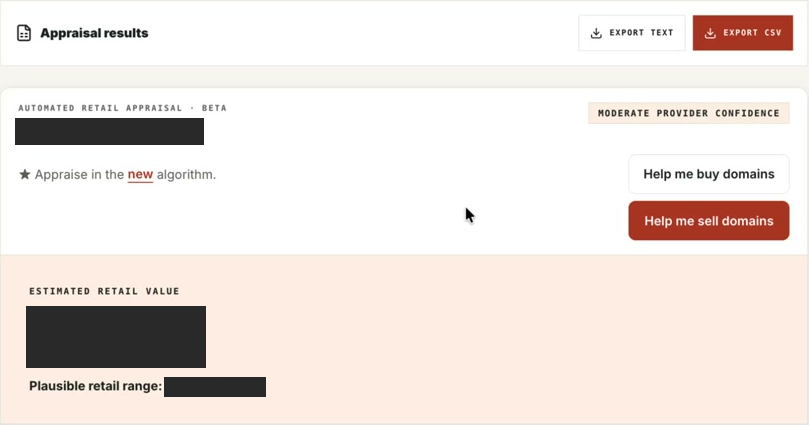
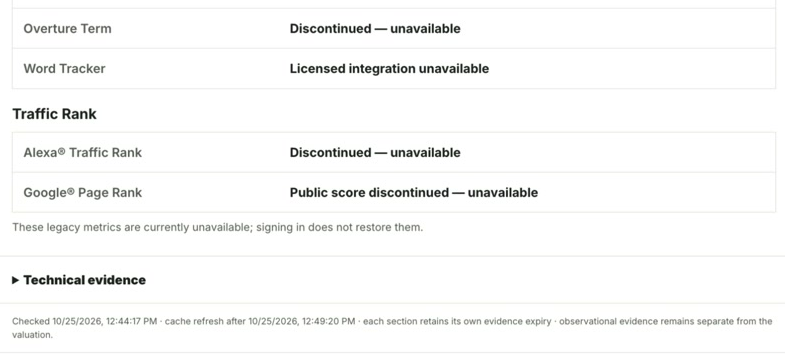
These are authentic historical cropped screenshots from an October 25, 2026 recording, with the candidate and estimated value/range redacted. This is not a complete or live report.

Estimates—not guaranteed sale prices. There is no guarantee of sale or accuracy. Screenshot controls are not interactive; the interface and available evidence may differ today.

Historical partial appraisal interface with the candidate, estimated value and range hidden by opaque redactions.
Partial appraisal view from the recording, not a reconstructed example or a complete evidence report. The legacy export and buy/sell controls shown are image pixels, not available actions here. Open the appraisal crop at full resolution.
Historical unavailable-evidence warnings and original checked, cache and expiry timestamps, with valuation-separation guidance.
Original unavailable and freshness warnings from the same recording. The checked, cache and expiry timestamps are historical observations, not current provider status. Signing in does not restore discontinued metrics. Open the limitations crop at full resolution.

Three ways to inspect the output

The partial genuine excerpt above shows historical interface evidence. The field glossary explains terms, not a live appraisal. The educational video explains how to read a range, evidence, and missing data; it is not proof of accuracy or a completed customer report. None starts an appraisal or is required before you run your own.

Educational walkthrough: How to Read a Domain Appraisal: Range, Evidence & Missing Data | SparkNamer
01

Choose for a one-off check or an ongoing investor workload

Start with the decision and frequency, not a preferred brand. A one-off owner can use a free check to understand an estimate and identify further research; that does not by itself justify a subscription. An investor regularly screening or pricing names should compare the work they actually repeat, supported batch size, usage limits, source visibility, and recovery when a check cannot finish.

Use the same candidate to compare value definitions, available evidence, and missing checks. Note which observations you can inspect and which checks still require another source. Do not choose a tool because it prints the highest amount, and do not infer equal evidence coverage from similar feature names. Paying does not restore unavailable or discontinued evidence, and account creation is not proof that research was saved.

  • One-off task: can I understand this estimate and finish my immediate check?
  • Repeated task: does the supported workflow and capacity fit my actual screening or pricing work?
  • Evidence: are sources, dates, gaps, and the difference between estimates and observations inspectable?
  • Service: can I recover my permitted work and get help without being promised a sale or unsupported accuracy?
Start with the existing free appraisal allowanceUse a like-for-like note when estimates disagree
02

A complementary candidate-evidence check

Whether or not you use EstiBot, keep your existing appraisal process if it serves your screening or pricing job. SparkNamer can add a complementary candidate-evidence check without asking you to switch an entire tool suite.

Inspect available comparable records and their sale dates, keyword-demand scope and observation dates, extension and technical observations, and missing evidence in your result. Coverage is conditional, not a promise that every optional check runs or finds data. Independently verify unresolved checks; missing evidence is not a clean bill of health, and separately returned sale rows do not recalculate the headline estimate.

This is not a replacement for bulk portfolio appraisal, API access, or lead workflows. It does not guarantee a buyer or acquisition and is not a claim of universally lower pricing. A switching survey is optional and not required before appraisal.

03

Questions to ask before choosing

Evaluate the product’s data coverage and workflow, not only the number printed at the top.

  • What value definition does it use?
  • Can you inspect sources and freshness?
  • Does it support individual or bulk work?
  • How does it represent missing and conflicting evidence?
04

Keep tools in their lanes

An automated valuation, trademark screen, availability check, and marketplace listing each answer a different question. Combining them is useful; collapsing them into one conclusion is risky.

05

Where SparkNamer fits today

Use SparkNamer for small-candidate screening: an automated retail estimate and plausible range with available evidence and limitations. The public Beta includes a one-time allowance of 5 free appraisals without sign-in. The anonymous allowance does not reset. Free accounts include 3 lifetime appraisals and can save private candidates and notes. After available free allowances are exhausted, further appraisals require an active paid or complimentary plan. Its 5-domain batch ceiling is subject to remaining access. It is not a public appraisal API, portfolio-scale service, or general sales-history search engine.

  • Best fit: inspect a screening estimate and the evidence actually returned
  • Not established: superior accuracy, a willing buyer, acquisition cost, or complete comparable coverage
06

EstiBot: evaluate the broader investor-tool job

EstiBot documents automated appraisal, bulk work, and account-based API access. Compare those requirements against its first-party tools and API documentation rather than treating SparkNamer as a drop-in replacement. Its Guest input accepts up to two domains per submission; this is not a verified daily allowance.

Paid EstiBot prices were not verified. Check the current account/signup terms, included tools, billing period, and usage limits before subscribing. A documented feature is not proof that it is included with every account.

07

Atom: distinguish the public tool, extension and developer offering

Source check: November 15, 2026—not this guide's publication date. Atom's public appraisal FAQ currently lists .com-only support. Treat that as the public tool's documented scope, not a tested boundary for every Atom surface.

The Chrome extension documentation describes a hover-and-click workflow with an appraisal sidebar and account credentials; it is separate from the anonymous public tool. Atom's developer documentation describes a programmatic offering. Documentation is not an executed result and is not a verified account entitlement. These surfaces do not establish API parity or equal model, evidence or extension coverage.

The two extension help pages have inconsistent lower-tier allowance tables. We advertise no definitive free quota from those conflicting descriptions. Verify your own current access and terms directly with Atom before depending on a workflow; do not infer entitlement from documentation alone.

Use the same candidate and record the surface, value definition, date, inspectable evidence and missing checks. No live appraisal or API request was run for this guide, and no paid request is needed to read it. This is not a superiority claim or a guaranteed sale.

08

GoDaddy: a domain-only estimate for another reference point

GoDaddy's domain-only appraisal uses sales data and machine learning, not a valuation of an operating website. Its October 2026 announcement changes the public-model comparison: identify the surface and model before comparing a current public result with a historical estimate or the documented API.

Use the estimate as another reference point, not a reason to average unlike valuations or prefer the largest amount. Current account quotas and paid prices were not independently verified; a higher display cap is not more free appraisals, a verified paid entitlement, or evidence of better accuracy.

Compare the dated EstiBot and GoDaddy model and evidence boundaries
09

GoDaddy's October 2026 update: compare surface, model, date, and evidence

Source review: November 12, 2026. GoDaddy's canonical news announcement is dated October 8, 2026 and says the rebuild started in November 2025. It describes a new public model available on the Domain Value Appraisal page, domain search, and Afternic. The public display cap is $1,000,000, with $1,000,000+ above that ceiling. A capped display is not an exact valuation, a price entitlement, or a buyer offer.

Source review: November 18, 2026. The current developer guide recommends v2 for new integrations and retains v1 for existing integrations. It does not identify API model lineage or establish public/API parity with the new public model; API model lineage remains unverified. The November 12 and November 17 reviews remain historical source observations. The current guide's publication or update date is not established. A documentation difference is not evidence of a migration or launch after November 12, verified rollout timing, an executed API behavior change, or improved accuracy.

The October announcement lists Domain Academy bulk valuations, the valuation API, GoDaddy Auctions, and Portfolio Manager as Coming in Q4 2026. These surfaces are not verified as launched with the new model in this review. The guide describes a subscription-based API; documentation of an existing endpoint does not verify migration to the new public model.

Read an API result in context: preserve GET /v1/domains/govalues, the domainName query parameter, version and observation date. In v1 money objects, currencyCode is USD and value is an integer in whole USD dollars, not cents: 1234 means $1,234. goValue is an estimate; listPrice is a suggested Afternic list price; goValueWholesale is a wholesale estimate; minPrice and maxPrice bound the range. Do not substitute one for another, treat a suggested list price as an offer, or treat a wholesale estimate as a settled investor sale. The guide's sample response is illustrative, not a real appraisal observed here.

For v2, preserve GET /v2/domains/domain-names/{domain-name}/govalue and the domain-name path parameter, not the v1 query shape. The v2 response omits status, goValueWholesale, listPrice, salesProbability, salesProbability500, salesProbabilityWholesale, minPrice and maxPrice. It returns domainName, goValue, maxDailyUsage and dailyUsage: an estimate and daily usage, not the v1 pricing and probability set. Omitted fields are not null and not zero; do not fill them from another version. The v2 reference and workflow differ on IDN handling; support remains unresolved here, not an advertised capability.

Keep yearly sales probabilities separate from prices: salesProbability is a decimal from 0 to 1 conditional on the GoValue price; salesProbability500 concerns a $500 price and salesProbabilityWholesale the wholesale value. These vendor predictions are not your personal sale probability or a guaranteed time to sell. Confidence and probability are not interchangeable. The API guide does not supply an independent accuracy or calibration test, an inspectable comparable-sales record, or a capability offered by SparkNamer.

Version-specific errors: v1 404 VALUATION_NOT_FOUND means a supported TLD has no valuation for that domain; v1 422 UNSUPPORTED_TLD means the TLD is unsupported. In v2, 400 covers an invalid domain or unsupported TLD; v2 404 means GoDaddy blocks the domain from appraisal. The v1 error body uses status and message; v2 uses name, correlationId and message. These errors are documented as non-retryable and supply no valuation, not zero value or zero demand. These are documentation semantics, not executed results. No API request, subscription, pricing or accuracy was verified for this review.

GoDaddy says comparable sales are not displayed yet for the new model. Sales data used by a model is different from completed-sale records you can inspect. Do not treat absent comparables as proof of no relevant sales, or assume a legacy result and a new-model result expose the same evidence. No live appraisal, API response, accuracy benchmark, paid price, or account quota was tested here.
  • Surface: record the exact product/page or API version: ____. Do not label every GoDaddy result as the same model.
  • Model: record the disclosed model/version or mark unknown: ____. Keep a historical estimate tied to its original surface and date; do not relabel it after an announcement.
  • Date: record result time: ____; source publication date: ____; source checked date: ____. An announced quarter is not an observed launch or an input-refresh guarantee.
  • Evidence: record the value definition, currency, cap, visible completed-sale records and gaps: ____. If comparables are unavailable, verify independent sale provenance and differences; do not average unlike estimates into a bid.
10

Choose the task, then compare a result

For one candidate, compare the estimate type, range, evidence, missing checks, and source dates. For repeated portfolio or programmatic work, evaluate throughput, API terms, export needs, and current cost directly. For selling or buying, verify actual buyer/seller interest and acquisition terms separately; none of these estimates establishes a guaranteed sale.

Review small-batch workflow boundaries before choosing bulk toolingDistinguish business-fit research from confirmed buyer interest

Sources and evidence status

Current first-party pages support dated product statements. Archived pages support historical feature descriptions, not current prices or limits. Dated user reports describe individual experiences; third-party reviews are not universal accuracy benchmarks. Recheck current product pages before purchasing.

  1. EstiBot Guest appraisal

    Checked 2026-10-18. Two-domain per-submission boundary in the prior first-party review; this recheck timed out. No daily quantity or paid entitlement inferred.

  2. EstiBot API information

    Checked 2026-10-18. Prior usable first-party documentation describes account-based access and links to GitHub; this retrieval timed out. Current paid prices remain unverified.

  3. GoDaddy model announcement — October 8, 2026

    Checked 2026-11-12. Canonical news article rechecked: original October 8 publication, rebuild timing, public surfaces, $1,000,000/$1,000,000+ display, comparable-sales visibility and announced Q4 surfaces. Announcement evidence, not a live appraisal or rollout test.

  4. GoDaddy developer valuation documentation — pricing signals and API limits

    Checked 2026-11-18. Current guide rechecked November 18; November 17 and November 12 reviews remain historical observations, not current guide update dates. Recommends v2 for new integrations and retains v1 for existing integrations. Documents v1 whole USD dollars, not cents; v2 omitted pricing/probability fields and version-specific errors. Publication or update date is not established; the documentation difference does not verify rollout timing or a model migration. Model lineage and public/API parity remain unverified; no API request, subscription, account entitlement, paid price or prediction accuracy was tested.

  5. Atom public domain appraisal

    Checked 2026-11-15. Public FAQ lists .com-only support. Direct retrieval returned 403; public text was refreshed through an anonymous reader. Documented scope, not a live appraisal or verified entitlement.

  6. Atom domain appraisal Chrome extension

    Checked 2026-11-15. First-party hover/sidebar workflow and account setup documentation. Its lower-tier allowance table conflicts with the separate limits article; no definitive quota inferred.

  7. Atom extension daily-limits help

    Checked 2026-11-15. Conflicting lower-tier documentation, not verified account access or an advertised free allowance.

  8. Atom developer platform

    Checked 2026-11-15. First-party programmatic offering documentation only, not an executed result, API parity test or verified account entitlement.

Related domain research

Questions

Frequently asked questions

What is the best domain appraisal tool?

There is no universal best tool. Choose based on the domain type, data transparency, workflow scale, value definition, and decision you need to make.

Is SparkNamer already a complete EstiBot replacement?

No. SparkNamer offers a Beta automated retail appraisal with available evidence and limitations in that same result. It does not offer a public appraisal API, portfolio-scale appraisal, or a licensed general sales-history database; it does not claim feature-for-feature suite parity.

Start with one real candidate

Review a domain you own or may acquire.

Run an Automated Retail Appraisal — Beta without signing in. Review the rounded range, provider confidence, market-category context, and visible limitations.

Try a candidate check