Value-checking framework

Checking domain value should expose the signals—not stop at a price.

A domain value checker can quickly summarize measurable signals. The result becomes more useful when you can distinguish strong evidence from assumptions and unresolved data.

One-time 5 free appraisals without sign-in; the allowance does not reset. Free accounts include 3 lifetime appraisals and can save private candidates and notes. After available free allowances are exhausted, further appraisals require an active paid or complimentary plan.

Inspect the output field guide — not a live appraisal
No sign-in to startUp to 5 domains per batchRanges and limitations visible

Partial recorded result · October 25, 2026

A recorded appraisal excerpt, with its limitations

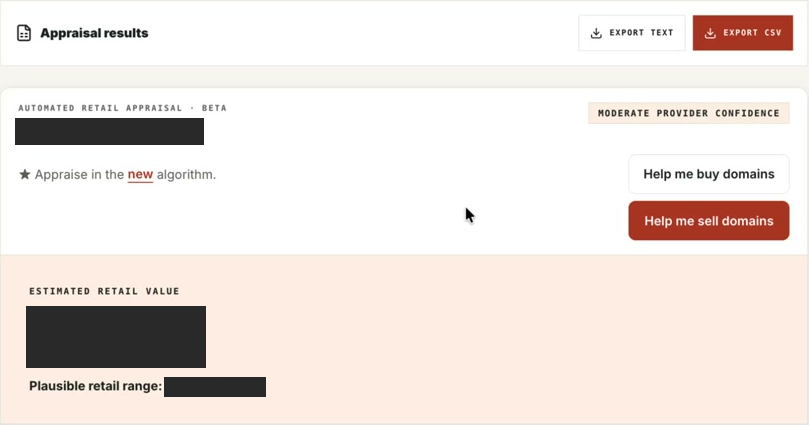
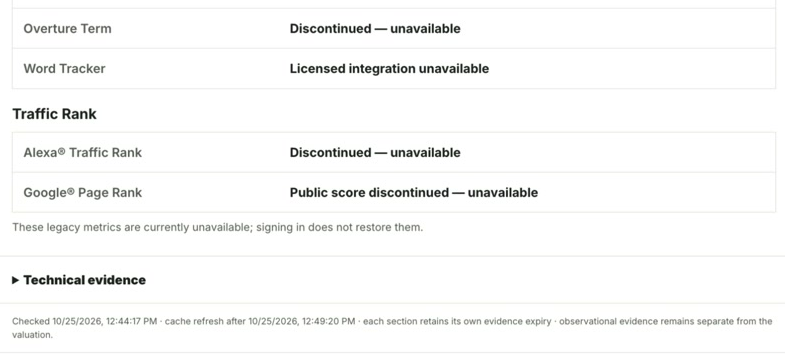
These are authentic historical cropped screenshots from an October 25, 2026 recording, with the candidate and estimated value/range redacted. This is not a complete or live report.

Estimates—not guaranteed sale prices. There is no guarantee of sale or accuracy. Screenshot controls are not interactive; the interface and available evidence may differ today.

Historical partial appraisal interface with the candidate, estimated value and range hidden by opaque redactions.
Partial appraisal view from the recording, not a reconstructed example or a complete evidence report. The legacy export and buy/sell controls shown are image pixels, not available actions here. Open the appraisal crop at full resolution.
Historical unavailable-evidence warnings and original checked, cache and expiry timestamps, with valuation-separation guidance.
Original unavailable and freshness warnings from the same recording. The checked, cache and expiry timestamps are historical observations, not current provider status. Signing in does not restore discontinued metrics. Open the limitations crop at full resolution.

Three ways to inspect the output

The partial genuine excerpt above shows historical interface evidence. The field glossary explains terms, not a live appraisal. The educational video explains how to read a range, evidence, and missing data; it is not proof of accuracy or a completed customer report. None starts an appraisal or is required before you run your own.

Educational walkthrough: How to Read a Domain Appraisal: Range, Evidence & Missing Data | SparkNamer
01

Define the value you are checking

Start with the exact domain and the decision: pricing an owned name, assessing a possible purchase, or screening a renewal. SparkNamer's Beta returns an automated retail estimate and plausible range for the domain name. Retail end-user value, an immediate wholesale sale, a seller's asking price, and the value of a revenue-producing website are different things.

When two tools disagree, first record their value definitions, appraisal dates, ranges, and limitations. Compare like-for-like outputs. Do not average a retail estimate with a wholesale bid or treat a model confidence score as the probability that a buyer will pay. A higher number is not independent evidence of demand.

02

Separate signal types

Comparable sales, search demand, registered-extension footprint, active company use, traffic, and linguistic quality answer different questions. One strong signal should not silently substitute for another.

03

Marketplace admission is not a reason to register

An appraisal and a marketplace admission result answer different questions. Atom's March 30, 2026 announcement describes instant Premium approval for some domains, with manual review still available for others. That is a platform's listing decision, not a buyer offer, sale probability, or time-to-sale forecast. Its announcement does not publish a universal dollar appraisal threshold for eligibility. Do not turn a participant's reported estimate into an admission rule.

If an appraisal and eligibility result come from the same evaluation system, they are not independent confirmations of resale demand. Nor does rejection prove a name has no value: the marketplace's selection job differs from your intended use. Premium marketplace admission is not registry premium pricing; verify registration and renewal charges separately.

Before registering a borderline name, write a buyer use case and compare available alternatives without relying on the badge or estimate. Record independent completed-sale evidence, material name differences, actual use, and unresolved history or conflict checks. Set a registration and holding budget you can accept if no buyer appears; do not calculate expected profit by subtracting fees from the appraisal. A missing decisive check can justify waiting or passing, not assuming it will work out.

Copy the short note below privately. This is a manual research aid: it does not verify Atom eligibility, register a domain, or list it. SparkNamer's separate appraisal does not settle those decisions or replace the platform's current terms. Recheck eligibility and applicable listing conditions directly before relying on them.

  • Eligibility result / source / checked date: ____ | Estimate definition and date: ____
  • Buyer use case / available alternatives: ____ | Why this exact name: ____
  • Independent evidence / source / missing checks: ____ | Same-system signals: ____
  • Registration / renewal quotes / holding budget: ____ | If no buyer appears: ____
  • Reason to pass / next check / my decision and date: ____
Review independent completed-sale evidence and comparable differencesKeep registration and holding costs separate from the estimate
04

Check confidence, not just output

Ask how many close comparables exist, how recent they are, whether the exact phrase has demand, and whether a buyer-specific use case is driving the apparent value.

05

Resolve conflicting estimates without choosing a winner

Put two outputs side by side for the same exact domain. Record currency, appraisal time, retail versus wholesale definition, range, and stated limitations before comparing amounts. If the definitions differ, leave them in separate columns rather than averaging. If they match but ranges diverge, inspect each source and observation date; agreement between models is not independent transaction evidence either.

Ask which specific observation would change your pricing or purchase decision: a relevant completed sale, an actual inquiry, a current cost, or evidence about the proposed use. Do not make the midpoint a target price or replace an unavailable check with the more reassuring estimate. If the necessary evidence cannot be verified, keep the difference unresolved.

  • Estimate A: provider / date / currency / definition / range / limitations: ____
  • Estimate B: provider / date / currency / definition / range / limitations: ____
  • Shared observations versus differing assumptions: ____
  • Still unresolved: ____; next check / source / decision affected: ____
Choose a tool by evidence visibility and the job you need
06

Build a value-checking worksheet

Keep a research note with one row per question: what was checked, its source, the observation date, the result, the limitation, and the next verification step. The worksheet is a manual decision aid, not a promise that every check is included in the free appraisal.

For price support, record completed-sale candidates and explain why each is comparable. A seller's asking price is not a completed-sale record; market-category ranges are not transaction evidence. For demand, distinguish the exact phrase, market, and measurement period from general category popularity. Registered extensions and active websites can suggest uses to investigate, but do not establish willing buyers, traffic quality, or revenue.

  • Estimate: value definition, range, appraisal date, and model limitations
  • Sales: reported price, sale date, venue, source, and material differences
  • Demand and use: actual observation, market, freshness, and missing coverage
  • Decision: acquisition cost, renewal cost, unresolved risks, and next check
07

Copy a blank listing-price review note

Listing views but no offers: would scheduled BIN cuts tell you anything? A dated record can show what happened, but no inquiries does not isolate price. Exposure, audience, format, timing, and the name itself remain alternative explanations. Start with your objective: quicker liquidation or acceptable net proceeds, not a target borrowed from an appraisal.

Copy this blank note into your own document for each listing window. Record only what the channel actually reports: views can include repeat visits or bots, while off-platform interest may be unreported. A view is not a qualified inquiry; note a buyer's specific purchase question or offer separately without copying private correspondence.

Choose one change at a time and a review window before acting; retain the prior entry. If you change price, record the previous and new ask, effective time, and anything else that changed. A before/after difference is not causal proof: different visitors or market conditions may explain it. An unchanged comparable group can add context, but differing names and audiences still limit comparison.

Time-to-sale and liquidity cannot be inferred from an appraisal or one before-and-after. Mark unobserved exposure and unknown outcomes explicitly; use zero only for a measure actually checked within the stated window. Review completed paid outcomes separately from asking prices, then decide whether to hold, investigate another constraint, or revisit your own price and carrying-cost limits. This manual note is not automatic repricing, an API, or views tracking; it is not a recommended cut or a sale guarantee.
  • Channel: ____; audience (investor / end-user / unknown): ____
  • Date / window: ____; objective: ____
  • Format (BIN / offer / auction): ____; ask / currency: ____
  • Recorded exposure: ____; source / measurement limits: ____
  • Qualified inquiries: ____; views: ____
  • Completed paid outcome / date / net proceeds: ____; not an asking price
  • Single change / effective time: ____; simultaneous changes: ____
  • Unobserved / unknown: ____; next evidence to check: ____
  • Next review: ____; decision / reason: ____
Check completed-sale evidence, not listing asksReview carrying costs before the next renewal
08

Treat missing evidence as a question, not a value

Optional evidence depends on configured coverage. Not requested and unavailable are distinct from an observed result. No comparable rows from one bounded source does not establish that the domain never sold; missing search evidence is not proof of zero demand. Keep those gaps visible rather than substituting invented numbers.

If close sales or buyer-use evidence are missing, widen the research carefully or leave the decision unresolved. The related sales-history guide explains how to separate an exact-domain sale search from similar-name comparisons. The free appraisal is a screening starting point, not a substitute for those checks.

09

Connect value research to acquisition reality

A potentially valuable domain can still have an unattractive acquisition route, high carrying cost, active conflict, or uncertain availability. Verify the current seller or registrar offer separately. Add acquisition cost, renewal cost, and applicable transaction fees to your own cost worksheet; the appraisal range does not calculate your net proceeds or investment return.

For an owned name, review actual inquiries and your pricing or renewal objective without treating an estimate as a buyer offer. For a purchase, resolve the material status, use, cost, and conflict questions before setting your own maximum spend. A research gap can justify waiting or passing; it does not justify a confident buy recommendation.

Build a separate domain acquisition-cost ledgerUse a manual next-renewal decision note for an owned domain

Sources and evidence status

Current first-party pages support dated product statements. Archived pages support historical feature descriptions, not current prices or limits. Dated user reports describe individual experiences; third-party reviews are not universal accuracy benchmarks. Recheck current product pages before purchasing.

  1. Atom: Introducing Instant Premium Listings — March 30, 2026

    Checked 2026-11-06. Current first-party announcement reviewed: instant approval for some domains, manual review for others, and appraisal/dashboard/submission surfaces. No universal dollar threshold stated. Documentation evidence only; no eligibility check, account, submission, appraisal, registration, or sale tested.

  2. NamePros: Atom's Instant Premium Eligibility — November 5, 2026

    Checked 2026-11-06. Original author's qualitative question about whether an estimate and eligibility justify registering a borderline candidate; four-post context reviewed via public reader after native access was blocked. Not measured demand, verified eligibility policy, transaction evidence, or an accuracy benchmark.

Related domain research

Questions

Frequently asked questions

Why do domain value checkers disagree?

Providers can use different datasets, comparable-selection rules, refresh schedules, value definitions, and model weights.

Should I average two domain value estimates?

Not automatically. First compare value definitions, observation dates, ranges, and evidence. A retail estimate and a wholesale bid answer different questions; averaging them does not create a verified selling price.

Does unavailable search or sales evidence mean my domain has no value?

No. Not requested, unavailable, and no rows from a bounded source describe evidence coverage, not zero demand or a zero valuation. Record the missing check and investigate it separately.

Can SparkNamer tell me exactly what my domain is worth?

No tool can guarantee an exact future transaction. SparkNamer's Beta provides an automated retail estimate and plausible range. Review available evidence and independently verify acquisition details.

Start with one real candidate

Review a domain you own or may acquire.

Run an Automated Retail Appraisal — Beta without signing in. Review the rounded range, provider confidence, market-category context, and visible limitations.

Run Free Appraisal