Appraisal comparison

EstiBot and GoDaddy can give you numbers. Your next step is checking the evidence.

Two automated estimates can disagree because their datasets, update schedules, comparable selection, marketplace context, and model assumptions differ. Agreement can be useful context, but it is not proof of a future sale price.

One-time 5 free appraisals without sign-in; the allowance does not reset. Free accounts include 3 lifetime appraisals and can save private candidates and notes. After available free allowances are exhausted, further appraisals require an active paid or complimentary plan.

Inspect the output field guide — not a live appraisal
No sign-in to startUp to 5 domains per batchRanges and limitations visible

Partial recorded result · October 25, 2026

A recorded appraisal excerpt, with its limitations

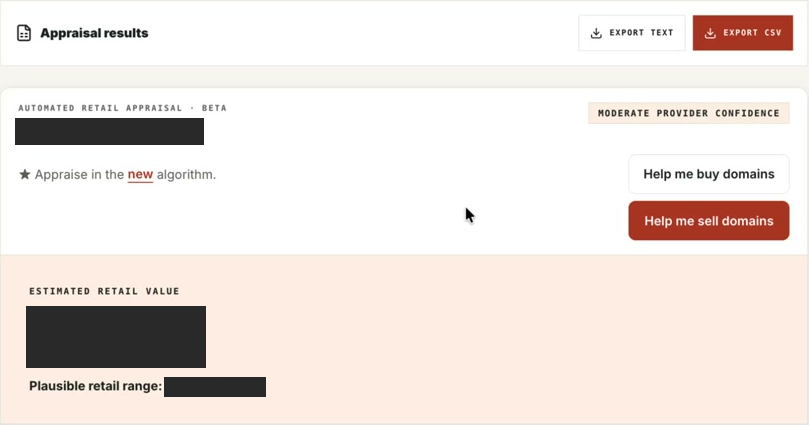
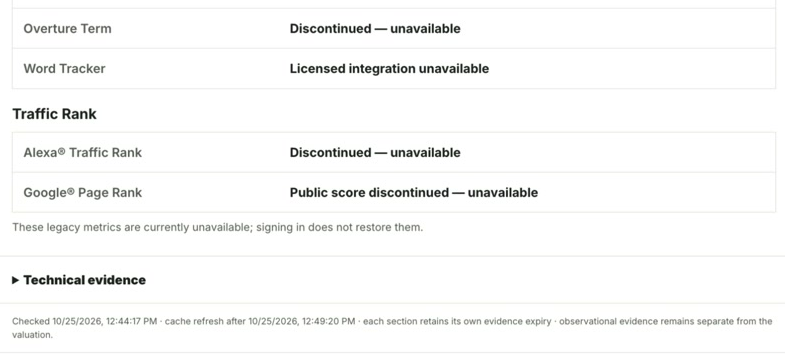
These are authentic historical cropped screenshots from an October 25, 2026 recording, with the candidate and estimated value/range redacted. This is not a complete or live report.

Estimates—not guaranteed sale prices. There is no guarantee of sale or accuracy. Screenshot controls are not interactive; the interface and available evidence may differ today.

Historical partial appraisal interface with the candidate, estimated value and range hidden by opaque redactions.
Partial appraisal view from the recording, not a reconstructed example or a complete evidence report. The legacy export and buy/sell controls shown are image pixels, not available actions here. Open the appraisal crop at full resolution.
Historical unavailable-evidence warnings and original checked, cache and expiry timestamps, with valuation-separation guidance.
Original unavailable and freshness warnings from the same recording. The checked, cache and expiry timestamps are historical observations, not current provider status. Signing in does not restore discontinued metrics. Open the limitations crop at full resolution.

Direct comparison

EstiBot vs GoDaddy appraisal: questions to compare

The useful comparison is not which page shows the larger number. Record what each output represents, when it was produced, and what evidence you can inspect.

Primary job

What is each result designed to help me do?

EstiBot
Automated appraisal within a broader investor-tool suite; check the documented account and API boundaries.
GoDaddy
Domain-only appraisal using sales data and machine learning, not an operating-website valuation. The October 8, 2026 announcement describes a new public model on appraisal, search, and Afternic; do not assume the documented v1 static API model is the same.
Unresolved

Value definition

Is this a sale price or an estimate?

EstiBot
Record the value definition and context displayed with the result; an estimate is not a buyer offer.
GoDaddy
A domain-name estimate is not a guaranteed transaction price, business valuation, or offer to buy.
Unresolved

Comparable evidence

Can I judge whether the cited sales are genuinely similar?

EstiBot
Inspect the actual result and sale provenance; a tool listing alone does not establish comparable quality.
GoDaddy
The announcement says comparable sales are not displayed yet for the new model. Training on sales does not provide inspectable sale-level provenance; check independent completed-sale evidence rather than assuming legacy comparable visibility.
Unresolved

Freshness

When was the result and its supporting evidence observed?

EstiBot
Record the appraisal date and any source dates shown; do not assume every input refreshed with the estimate.
GoDaddy
Record surface, model/version, and result date separately from the October 8 announcement and October 29 source review. Coming in Q4 2026 does not verify a launch or an input-refresh interval.
Unresolved

Acquisition reality

Does an estimate prove I can acquire the domain at that price?

EstiBot
No. Verify availability, seller, route, and asking price independently.
GoDaddy
No. A registrar or marketplace offer must be checked separately from the appraisal value.
Unresolved
01

October 30 Auctions update: a separate comparable-sales surface

Source review: November 4, 2026. GoDaddy's October 30, 2026 Auctions announcement describes a revamped Domain Details page as available, including a Comparable Domains Sold section alongside website-history and third-party metrics sections. This is a separate Auctions sales-evidence surface, not the same claim as displaying comparables beside a new GoValue model result.

The October 8 model announcement still says comparables are not displayed yet for the new model and lists Auctions migration as Coming in Q4 2026. The October 30 Auctions article does not identify its appraisal model or establish that migration has occurred. A documented sales section is not proof that every listing has comparable coverage; the documented v1 API remains a static-model contract, not proof of parity with GoValue. No Auctions listing, live appraisal, API output, account quota, or accuracy was tested for this note.

02

GoDaddy's October 2026 update: compare surface, model, date, and evidence

Source review: October 29, 2026. GoDaddy's canonical news announcement is dated October 8, 2026 and says the rebuild started in November 2025. It describes a new public model available on the Domain Value Appraisal page, domain search, and Afternic. The public display cap is now $1,000,000, with $1,000,000+ above that ceiling. A capped display is not an exact valuation, a price entitlement, or a buyer offer.

The announcement lists Domain Academy bulk valuations, the valuation API, GoDaddy Auctions, and Portfolio Manager as Coming in Q4 2026. These surfaces are not verified as launched with the new model in this review. The developer valuation documentation explicitly describes v1 as a static model; that documented API contract is not proof that an API response uses the new public model.

GoDaddy says comparable sales are not displayed yet for the new model. Sales data used by a model is different from completed-sale records you can inspect. Do not treat absent comparables as proof of no relevant sales, or assume a legacy result and a new-model result expose the same evidence. No live appraisal, API response, accuracy benchmark, paid price, or account quota was tested here.
  • Surface: record the exact product/page or API version: ____. Do not label every GoDaddy result as the same model.
  • Model: record the disclosed model/version or mark unknown: ____. Keep a historical estimate tied to its original surface and date; do not relabel it after an announcement.
  • Date: record result time: ____; source publication date: ____; source checked date: ____. An announced quarter is not an observed launch or an input-refresh guarantee.
  • Evidence: record the value definition, currency, cap, visible completed-sale records and gaps: ____. If comparables are unavailable, verify independent sale provenance and differences; do not average unlike estimates into a bid.
03

A complementary candidate-evidence check

Whether or not you use EstiBot, keep your existing appraisal process. After comparing EstiBot and GoDaddy, use SparkNamer for a complementary candidate-evidence check rather than a tie-breaker based on the largest estimate.

Inspect available comparable records and their sale dates, keyword-demand scope and observation dates, extension and technical observations, and missing evidence. Coverage is conditional; optional checks may be unavailable or return no records. Independently verify unresolved checks, acquisition terms, and material conflicts. Supporting comparable rows do not recalculate SparkNamer's headline estimate or establish superior accuracy.

This is not a replacement for bulk portfolio appraisal, API access, or lead workflows. It does not guarantee a buyer or acquisition and is not a claim of universally lower pricing. A switching survey is optional and not required before appraisal.

04

When appraisals disagree: a candidate comparison note

Copy this note into your research and fill it in for each tool. Keep gaps visible rather than treating the higher estimate as the answer. This is a comparison checklist, not a Buy/Skip verdict.

  • Estimate context: tool: ___; value definition: ___; estimate date: ___. Retail, wholesale, and asking price differ; record which one the output describes or mark it unresolved.
  • Comparable evidence: record each actual completed sale separately from a listing or category estimate. Sale date: ___; source-checked time: ___; venue: ___; terms: ___; material similarities and differences: ___. These dates answer different questions; assess relevance without an arbitrary recency cutoff.
  • Search and technical evidence: exact phrase: ___; market: ___; language: ___; observation date: ___; technical observations and their dates: ___. Keyword demand is not domain traffic; registration is not checkout availability.
  • Unresolved and next verification: retain unavailable, expired, and conflicting inputs: ___; next check and source: ___. Verify the current seller, listing, and acquisition terms independently. Do not average estimates into a bid.
05

Editorial worked reasoning: a verified sale is not automatically a useful comp

These conditional examples apply two distinctions raised in public discussion. They are original editorial reasoning, not a customer case study or endorsement. No domain, price, sale or appraisal output is supplied or invented here.

If a completed transaction is verified, first compare the extension, buyer job, venue and terms. A verified transaction can still be a poor comp: a name bought for a specific operating business may not transfer to a candidate sharing only a keyword in another extension. Keep the transaction as context, explain the mismatch, and do not use it alone to justify a bid.

If the available close is an investor-auction purchase while the model describes an eventual end-user sale, a retail estimate and an investor-auction close answer different questions. The investor still faces holding costs, fees and uncertain resale demand; the spread alone does not prove either appraisal wrong or establish a profitable acquisition.

SparkNamer does not independently validate transactions through this comparison, import competitor estimates or choose a winning model. Inspect the actual source and transaction context yourself; optional comparable coverage may be incomplete or unavailable.

06

Editorial worked reasoning: three different comparable gaps

Missing records: if a bounded lookup returns no rows, record that coverage gap and check another appropriate source. It does not establish that no sale exists or that the candidate has no value.

Irrelevant records: if rows are returned but the extension, commercial use or buyer context differs materially, explain why they do not support the candidate's price. More rows do not repair a weak match.

Unverified records: if a reported amount lacks inspectable completed-sale provenance, retain it as unresolved rather than silently promoting it to a verified comparable. Check whether it is an asking price, model estimate or completed transaction, and preserve unknown venue and terms.

Keep these gaps separate in the comparison note: the next action is respectively broader source checking, better matching or transaction verification—not averaging tool estimates or treating uncertainty as zero.

07

Compare like with like

Record when each estimate was produced, what type of value it appears to represent, and whether the domain has close recent comparables. Avoid comparing a retail estimate with an acquisition price as though they answer the same question.

08

Investigate disagreement

A large spread is a reason to inspect the inputs, not average the numbers automatically.

  • Are the comparable sales genuinely similar?
  • Does search demand match the domain phrase?
  • Is value concentrated in one potential buyer?
  • Are current use, history, or legal conflicts material?
09

Separate value from availability

An estimate does not establish that a domain is available, purchasable at a registrar, listed at a marketplace, or obtainable at the estimated amount. Verify the actual acquisition route and its costs separately.

Sources and evidence status

Current first-party pages support dated product statements. Archived pages support historical feature descriptions, not current prices or limits. Dated user reports describe individual experiences; third-party reviews are not universal accuracy benchmarks. Recheck current product pages before purchasing.

  1. EstiBot appraisal page

    Checked 2026-10-18. Recheck timed out. Last usable first-party review: October 6, 2026. No current pricing or accuracy benchmark inferred.

  2. GoDaddy model announcement — October 8, 2026

    Checked 2026-10-29. Canonical news article reviewed: rebuild timing, new public surfaces, $1,000,000/$1,000,000+ display, comparable-sales visibility and Coming in Q4 2026 surfaces. Announcement evidence, not a live appraisal or rollout test.

  3. GoDaddy developer valuation documentation — v1 model contract

    Checked 2026-10-29. Documentation reviewed: v1 explicitly uses a static model. This API contract does not verify migration to the new public model, an executed API response, account entitlement, or current paid pricing.

  4. GoDaddy Auctions Domain Details announcement — October 30, 2026

    Checked 2026-11-04. Documents the separate Comparable Domains Sold section. Does not identify an appraisal model, prove new-model migration, or guarantee per-listing coverage. October 8 public-model announcement rechecked November 4; no live appraisal performed.

Related domain research

Questions

Frequently asked questions

Which appraisal is more accurate?

There is no universal answer for every domain. Accuracy depends on the domain type, data coverage, comparable relevance, model purpose, and the eventual buyer and transaction.

Is SparkNamer associated with EstiBot or GoDaddy?

No. SparkNamer is independent and is not affiliated with, endorsed by, or associated with EstiBot or GoDaddy.

What does SparkNamer add?

SparkNamer provides a Beta retail estimate and range with available evidence and limitations in the same appraisal result. It does not retrieve either competitor's estimate or establish superior accuracy, a guaranteed acquisition route, or a sale price.

Start with one real candidate

Research the domain before you acquire it.

Run an Automated Retail Appraisal — Beta without signing in. Review the rounded range, provider confidence, market-category context, and visible limitations.

Inspect the evidence